
Intrusive State Powers of CDA Islamabad and Human Rights Violations
By Zeeba T. Hashmi
On a rainy Sunday in March, anxious residents gathered at a church in Rimsha Colony, H-9, Islamabad. They prayed for justice and mercy. Outside, the Capital Development Authority had given them a three-day ultimatum to vacate the homes they had built and lived in since 2008. Three days.
This scribe visited Rimsha Colony on 19th March 2026 to understand what was happening on the ground, and in particular to understand what happens to children when their communities are uprooted. What follows is a story of a people who were first displaced, then resettled by the state, and are now facing displacement again.
Who Are The Residents?
Rimsha Colony has been named after Rimsha Masih, a minor girl with Down syndrome who faced a false blasphemy accusation and was later acquitted. Even after her name was cleared, her community continued to face threats from extremist clerics. The state itself relocated them to H-9 in 2008 for their safety. Today, they are victims of a double persecution: first by religious extremism, and now by the very state functionaries who once offered them refuge.
These residents have lived here for nearly two decades. They have built their houses and carry NADRA identity cards issued to the very address where they reside. Local elections have been held here; residents have participated in general elections. They earn their livelihood through irregular domestic work and menial labour, with no formal social protections. There are no proper water, electricity, or sanitation facilities — yet the only comfort they have is the affordability of a roof over their heads.
This is not a story about Christians alone. It is about all residents of these informal settlements who are being denied permanent residence and the dignity they deserve.
Discrimination and Education Deprivation
Approximately eight church-based and private schools have been established in Rimsha Colony and have been running for several years. Children here eagerly attend school — yet even before the threat of demolition, access to education has never been straightforward.
“We have a public school available just a kilometre away. Some of our children go there, but most prefer to drop out because of the discrimination they face owing to our religion.”
– Maryam, local school teacher, Rimsha Colony
Maryam also noted that parents have greater confidence in private and church-based schools than in government institutions. Children from these communities have been denied admissions at the nearby public school, making the private and community-run schools not a preference but a necessity. Now, those schools too are earmarked for demolition.

Approximately, there are eight church-based and private schools that have been established here and running for some years. There are children here who eagerly attend their schools, also earmarked for demolition.
“We have a public school that is available just a kilometer away from here, some of our children go there, but most prefer to drop out from there because of the sheer discrimination they face owing to our religion.” Maryam*, a local school teacher confided when narrating fearful tales of education deprivation faced by so many.
Discrimination is another form children here face, as she spoke of them getting denied admissions at a nearby public school that is not more than kilometer meter away. “Parents have more confidence in private or church-based schools here than they have in government schools” she added.
Eviction Impact: Education Loss for All
The loss of education is an impact that consistently goes ignored in eviction discourse. The Alliance for Urban Rights, an organisation working tirelessly for the housing rights and protection of katchi abadi residents, recently conducted an important education and health access survey across informal settlements in Islamabad. Data collected from 49 locations reveals that children aged 5 to 14 attend approximately 182 primary and middle schools — all now at risk of losing school access due to these evictions.
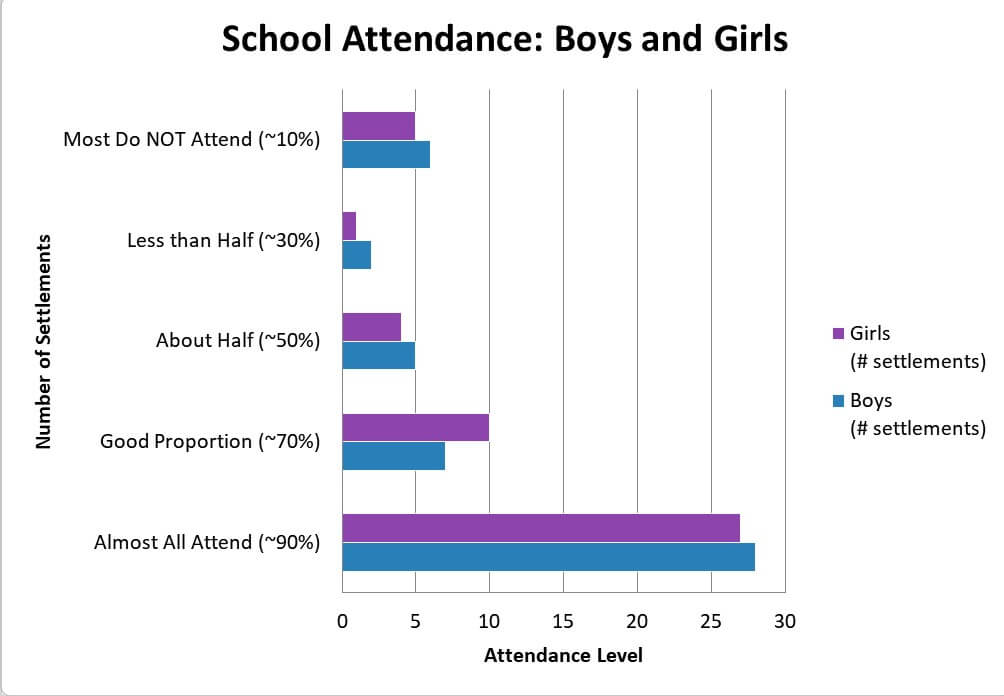 Of these 49 settlements, 28 (57%) report almost all boys attending school, while 27 (55%) settlements report almost all girls going to school — a finding that underscores how deeply embedded schooling has become even within these marginalised communities. The data also shows greater acceptance for private schools (56.3%) than public schools (43.7%), reflecting preferences for quality or a sense of safety.
With Pakistan already facing a national education emergency marked by very high dropout rates, forced evictions take no account of the educational loss that is their inevitable consequence. Adding to this is the trauma of not just losing access to school, but of losing a home. Denial of the right to education is a serious violation of a fundamental constitutional right. Such actions will further deepen the crisis by pushing thousands more out of classrooms — children who are already at a severe disadvantage and deprived of basic state services, including affordable housing and dignified living.
What Became of the Displaced: Compensation and Aftermath
Over 25,000 houses have been evicted from Bari Imam, Muslim Colony, and Noorpur Shahan. The CDA has compensated approximately 750 families, claiming it had provided alternative plots in 2001 and paid compensation in 2003, and that all other constructions are illegal and therefore outside its liability. Some affected residents dispute this, asserting their homes have stood for 30 to 40 years.
Demolitions have continued even after the Islamabad High Court issued a stay order in December 2025, and despite the Supreme Court’s 2015 stay order technically still being in effect. The story of Saidpur Village and Muslim Colony — once declared a “Model Village” by the authorities, only to be bulldozed — is a tale of lingering deceit by state functionaries.
Zeeshan Ahmed, a land rights activist and researcher behind the civil society mapping report Permanent Impermanence, has raised concern that no official surveys on Islamabad’s informal settlements have been conducted since 1996. He argues this may be deliberate — a strategy to keep settlements undocumented, invisible, unacknowledged, and legally non-existent. The last official CDA survey, conducted in 1990, documented only 10 informal settlements. Since then, 39 to 41 more have emerged, with a combined population estimated between 343,000 and 554,000. With roughly one fifth of Islamabad’s population living in these settlements, a pressing question demands an answer: where do these people go when the state fails to provide compensation or relocation?
In numerous documented cases, resettlement land that rightfully belonged to displaced residents has been illegally allotted to others.
What the Law Says on Evictions
There is a serious dilemma that must be addressed not merely from a moralistic standpoint, but on the basis of legal justification. Laws cannot be read without taking into consideration the human lives affected by them.
International law and global consensus treat forced evictions as a human rights concern. The OHCHR Basic Principles and Guidelines on Development-Based Evictions and Displacements define the issue plainly:
“Forced evictions are considered gross violations of human rights, particularly the right to adequate housing. They involve the permanent or temporary removal of people from their homes or land, often carried out by state authorities or private entities without legal protection or due process. This practice can lead to homelessness, destitution, and a lack of access to basic services such as food, water, and healthcare.”
According to all relevant international instruments, states are obligated to refrain from, and actively protect against, forced evictions. Pakistan is a signatory to these binding frameworks, including the UDHR, ICESCR, UN-CRC, CEDAW, and CERD. It is in violation of each.
Pakistan is equally in violation of its own domestic laws. Several domestic statutes govern eviction, and all require mandatory compensation, relocation, or prior resettlement. These include the Land Acquisition Act 1894 — a colonial-era law still unreformed — and the Katchi Abadis Act 1987, which provides for cash assistance or plot allocation. Provincial acts across Pakistan further protect settlements with over 30 years of documented existence. The National Housing Policy (2001) and the National Resettlement Policy (2002) both place human vulnerability at the centre of all considerations, at least on paper. In Islamabad specifically, the CDA Ordinance 1960 mandates regularisation of informal settlements, and the ICT Urban Katchi Abadi Regulations 2025 represent the most recent framework introduced.
Court Verdicts Pointing to CDA Irregularities and Abuse of Power
Significant court verdicts have raised concerns over inadequate compensation and sounded alarms over irregularities within the CDA, pointing to abuse of power and organised corruption.
In a landmark Islamabad High Court verdict on inherited lands acquired by the CDA, Justice Minullah decried the “abuse of the power of eminent domain” and pointed to the CDA’s unlawful allotments to its own employees, depriving thousands of rightful claimants of their entitlements. The court observed:
“Most of the victims are not even aware of their rights and thus they are vulnerable to exploitation because of an apparent collusion between unscrupulous investors and public functionaries. It was observed during the proceedings, and has become obvious from the material brought on the record, that the victims of the abuse of the power of eminent domain have not been treated justly, fairly, and as equal citizens of Pakistan. The way they have been treated by public functionaries shows that, as far as they are concerned, the fundamental right which guarantees inviolability of human dignity does not exist in the Constitution.”
CDA irregularities were also highlighted in the Greenbelt Plot Case (2024), in which CDA officials in 2021 carved out new plots on greenbelts adjacent to a stormwater channel in G-11 by establishing the “Regulation of Amendment in Layout Plan 2019,” despite the sector’s layout plan having been finalised in the 1990s. Residents challenged the new regulation, and Justice Sardar Ijaz Ishaq Khan rightly struck it down as unconstitutional.
The public outrage against CDA’s recent actions is met with strong denials by officials of any wrongdoing involved. They maintain that all informal establishments after declaration of regularized Katchi Abadis in 2002 are illegal hence they are subject to recovery of lands from encroachments. This stems for a need for the state to provide a remedy for a population of over 5lac people, coming from low-paid industry, who are being forcefully evicted from the houses they built, without being compensated.
Political Inconsistency over Evictions
It can be argued that forced evictions are class-preferential, something that the state officials deny. A serious incident was reported on 14th April when CDA officials, along with police and heavy machinery, commenced eviction operations in Bari Imam. Protesters have alleged that besides tear gas, pellet bullets were also fired at them, resulting in serious injuries to over a dozen residents, including minors. The media reported that anti-riot police counter-alleged that protesters had escalated the violence, which also resulted in eight policemen sustaining injuries. Several protesters were subsequently charged under clauses of the Anti-Terrorism Act — an action by the state that has been widely condemned and criticised by civil society.
Following this, on 7th May, Senator Sherry Rehman raised a question before the Minister of Interior and Narcotics regarding residents being shelled and forcibly evicted in Bari Imam without being allocated alternative residence or compensation. In response, Talal Chaudhry, Minister of State for Interior, denied that residents had not been compensated, claiming that the CDA holds records of awards made to claimants of ancestral lands. With respect to the particular settlement where the incident took place, he maintained that records are available for 101 plots awarded to claimants in the I-9 sector, and counter-alleged that residents had been profiting from their compensation claims. While he asserted that the law should be equal and consistent for all, he was simultaneously made a member of a ministerial committee formed to halt the eviction of residents of the high-rise One Constitution Tower — a building that had itself been deemed illegal.
A Test of State Accountability
De-humanising an entire community is always the first step of a state machinery before it takes its most grotesque measures. The legal grounds the state invokes for evictions may technically fall within the law. They may even be argued as justifiable. But they are cruel because they carry no weight for the poor.
The contrast is stark when it comes to treatment meted towards the rich and the poor. Influential residents of Constitution-1 Tower were able to halt their own demolition through legal and political means. For the Christian communities, the temporary halt in demolitions came not because their plight was heard, but because the issue drew international media attention and raised serious questions about the state’s treatment of religious minorities who are already persecuted.
This is a test for state functionaries to prove how authentic, unbiased, and fair they have been in their dealings with disadvantaged people. Reforms in policy and practice are urgently needed to ensure that state functionaries provide proper alternative arrangements for evicted families, while maintaining consistent and accountable conduct. Human rights and fair treatment cannot be guaranteed unless accountability mechanisms are embedded within institutions capable of detecting and preventing the kind of catastrophe unfolding in Islamabad today.
Zeeba T. Hashmi is an opinion writer and a researcher exploring themes of education that interconnect with issues of indoctrination, hate speech, knowledge barriers and politics on education. She runs her think tank, Ibtidah for Education.