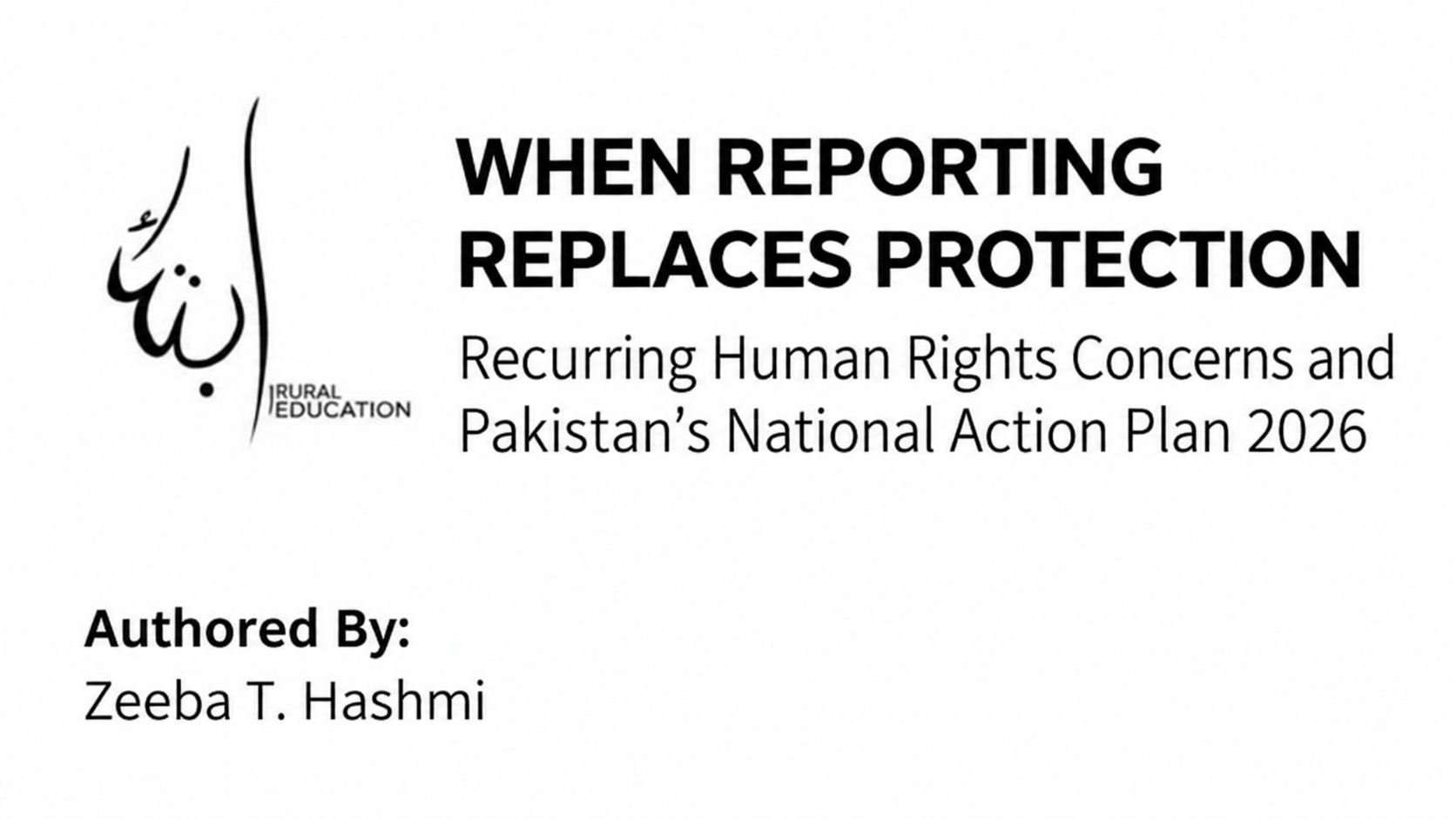
WHEN REPORTING REPLACES PROTECTION | Recurring Human Rights Concerns and Pakistan’s National Action Plan 2026
Human rights are a complex and layered subject, tied not only to the inalienable rights a person is born with, but to how those rights come to be recognised by the state that is responsible for safeguarding them. This book is a reflection on the factors that undermine human rights when the attention of the state is drawn instead towards “compliance reporting,” and when the government’s own defensive machinery is activated in the arena of international politics through its treaty obligations. What began initially as a brief review of the National Action Plan for Human Rights 2026, framed within the six thematic areas defined by the Ministry of Human Rights, it gradually developed into a broader study of human rights legislative and policy architecture and their reporting mechanisms that are meant to institutionalise the rule of law without compromising the rights guaranteed by the Constitution.
The methodology adopted is based on a comparative legal and policy analysis. Each chapter examines the domestic constitutional and legislative framework governing a particular right, Pakistan’s obligations under binding international treaties and relevant soft-law instruments, the recurring observations made through United Nations treaty bodies, the Universal Periodic Review, relevant Special Procedures, the European Union’s GSP+ monitoring framework and domestic oversight institutions. The analysis is further informed by this author’s field research, interviews with legal practitioners and human rights defenders, and builds upon previous research undertaken by Ibtidah for Education. The data has been compiled under specific categorizations defined by Ibtidah for Education that remain missed in mainstream, otherwise. Topically, this book also examines in detail the independence of the national statutory commissions working for human rights, the academic freedom and attacks on schools, the factors undermining fair trial guarantees and the misuse of laws, recurring observation on freedom of religion or belief, and the communities that remain ignored or unrecognized in protection policies, for example the indigenous and nomadic communities, and refugees and stateless children.
Based on the findings of this report, Ibtidah for Education believes that reporting mechanisms achieve their greatest value only when they become practical instruments of protection, enabling governments not merely to focus on compliance, but to demonstrate a grounded, well-intentioned resolve attuned to Pakistan’s internal and locally nuanced challenges. A challenge can only be addressed if a state is willing to identify, recognize and act on it, without feeling the requirement of the international obligations in compelling it to do so. We hope the learnings from this book will be helpful for all who are involved in human rights work in Pakistan. For more information, please contact the author Zeeba T. Hashmi at info.ibtidah@gmail.com