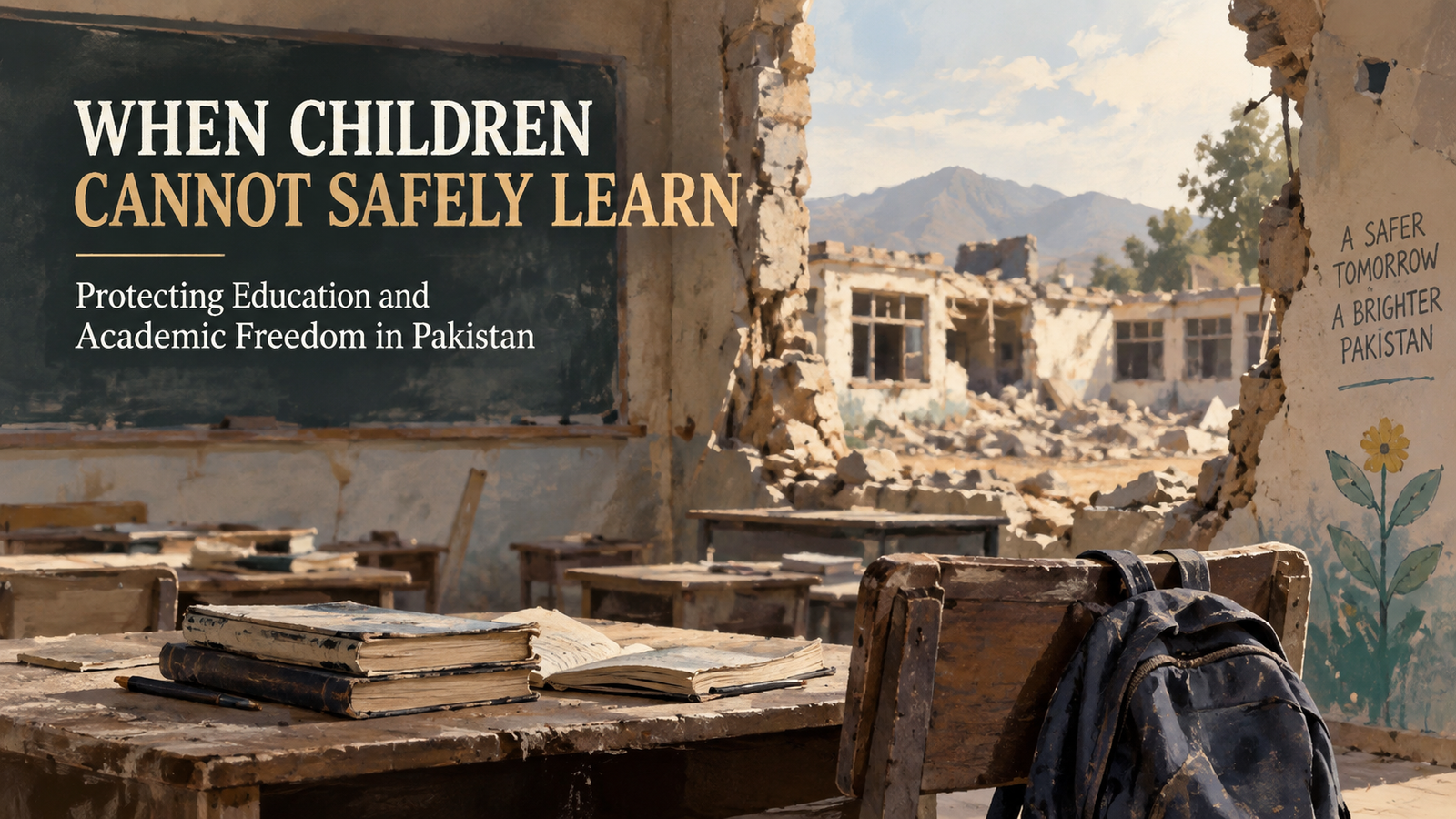
Education Under Attack: The Unaddressed Concerns for Academic Freedom and Security
When we speak about the right to education, the discussion in Pakistan usually revolves around access: how many children are out of school, how many schools need to be built, how many teachers are required, and how much money is being spent. But this conversation is incomplete without taking into account the safety and security factors that ideally should precede the debate around contents being taught and academic freedoms.
However, two fundamental questions remain largely missing from public discourse here: one, about school safety and ensuring educational continuity and access; and second, about academic freedoms and critical enquiry. The security concerns for the schools demand some resolve, and need concerted efforts involving the schools and administration to ensure their safety.
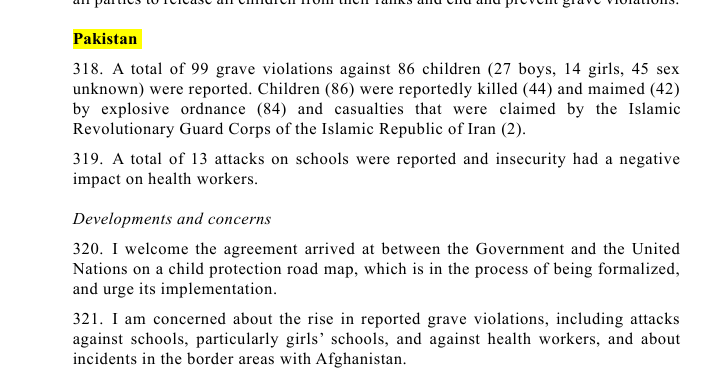
The local media in Pakistan has reported school attacks, either through IEDs planted by unidentified armed men in schools or through quadcopter attacks, mainly in Mir Ali, North Waziristan, in recent months. In May this year, UNICEF Pakistan also expressed alarm over at least nine such attacks on schools that are instilling fear among local communities. The GCPEA (Global Coalition to Protect Education from Attack) has also presented worrying statistics. Figures from 2024–2025, with at least 44 attacks on schools in Pakistan during the 2024–2025 reporting period. It may also be noted that in 2024, UN Secretary-General’s annual report on children and armed conflict reported thirteen attacks on students, teachers and other education personnel in two years, killing or injuring 31 people, most of them female students. Eleven attacks on higher education were recorded, nine of them against students and staff, including the alleged abduction of 13 Baloch students from university housing in Punjab in 2024.
A meaningful right to education requires children to be able to enter a school without fear, and a teacher to feel safe in engaging with children.
This is also the central concern emerging from Chapter 5 of Ibtidah for Education’s recently published When Reporting Replaces Protection: Recurring Human Rights Concerns and Pakistan’s National Action Plan 2026. The chapter, on which this blog is based, has examined education as a human rights obligation and argues that its protection has two dimensions: physical protection and intellectual protection.The first concerns the safety of schools, students, teachers and educational infrastructure. The second concerns the freedom to teach, learn, question and pursue knowledge without fear.
The first concerns the safety of schools, students, teachers and educational infrastructure. The second concerns the freedom to teach, learn, question and pursue knowledge without fear.
Children Caught in Conflict
The attack on the Army Public School in Peshawar on 16 December 2014 remains one of the most devastating examples. More than 141 people were killed, the overwhelming majority of them children. Yet the attack was not an isolated event. The research compiled for this report shows that attacks on educational institutions had already been occurring before APS and have continued in different parts of the country.
A destroyed school means lost months or years of education. Fear can keep parents from sending their children back. Girls may be withdrawn from school first. Teachers feel threatened. And children become more vulnerable to displacement, poverty, exploitation and threats by armed groups.
This is why an attack on a school should not be treated simply as an incident of terrorism or destruction of property. It is an attack on children’s rights and on the continuity of education itself.
The year before the APS attack saw at least 78 targeted attacks on schools, teachers and schoolchildren, including 26 attacks on female educational institutions. Between 2022 and 2023, attacks on schools declined to three and five respectively, but the decline did not represent the disappearance of the threat. By 2024–25, attacks rose sharply again: GCPEA recorded at least 44 attacks on schools, with 27 in 2024 and 17 in 2025. Ten attacks in 2024 and six in 2025 specifically targeted girls’ schools.
The violence has not come out of a vacuum.
In November 2024, an attack near a girls’ school in Mastung, Balochistan, killed five schoolgirls. In May 2025, an attack on a school bus in Khuzdar killed eight people, including six students. Later that year, teachers were abducted in Bannu, a school in North Waziristan was destroyed, and a drone strike on a madrassah in Tank injured nine children.
These incidents tell us something important: protecting education cannot be reduced to building schools.
What Happens After the Attack and Protection Frameworks
Children and families living in areas affected by attacks experience fear, uncertainty and economic disruption. The UN Security Council’s Monitoring and Reporting Mechanism, established through Resolution 1612, recognises attacks on schools as one of the six grave violations against children in armed conflict. Under the Convention on the Rights of the Child, Pakistan’s obligations include the right to education, the protection of children affected by armed conflict, and the recovery and reintegration of child victims. The relevant provisions include Articles 28, 29, 38 and 39. The International Covenant on Economic, Social and Cultural Rights also requires attention to the availability, accessibility, acceptability and adaptability of education.
Protection from attacks, and post-conflict rehabilitation needs to include security, psychosocial support, confidence-building, restoration of teaching, protection of teachers and students, and mechanisms for ensuring that education continues during and after periods of violence.
On financing, the structural concern is unchanged: at the time of the APS attack the federal budget allocated education roughly 2.1 per cent, which was already too low to cover ordinary costs let alone securing and rehabilitating schools; and the Khyber Pakhtunkhwa government’s comparatively higher allocation — Rs 362.68 billion for 2024–25 — has been criticised as disconnected from school-level realities. The main problem remains that of the government’s complete ownership of rehabilitating and securing schools affected by conflict.
Pakistan already has a Pakistan School Safety Framework developed by the National Disaster Management Authority. However, a broader human-rights framework is also necessary, particularly for education affected by armed conflict. For example, 50 schools destroyed by terrorism in Bara and adjoining areas of Khyber district — 35 primary, seven middle, seven high and one senior high — were reconstructed at a cost of Rs 3.21 billion and inaugurated in February 2026, executed with the financial and technical assistance of China.
Pakistan has also repeatedly been encouraged to endorse the Safe Schools Declaration, a voluntary international political commitment aimed at protecting education during armed conflict, preventing military use of schools, improving data collection, supporting victims and ensuring continuity of education. Pakistan has not endorsed the Declaration.
Invisible Attacks on Education: Threats to Academic Freedom
There is another form of violence against education that is less visible. A school may remain standing. Its classrooms may be intact. Students may continue attending. But if teachers are afraid to discuss certain subjects, students are discouraged from asking questions, or academics are threatened, prosecuted or forced into public apologies for their views, education is still being undermined.
This is where academic freedom becomes a human rights issue.
The research undertaken by Ibtidah for Education documents cases between 2013 and 2025 involving academics who were killed in religiously or sectarian-motivated attacks, formally prosecuted under blasphemy or PECA-related laws, or forced to publicly apologise following clerical or community pressure. The report categorises the cases into three broad forms of suppression:
- Religiously motivated killings or attacks against academics;
- Formal prosecutions under blasphemy or PECA-related laws; and
- Coerced public apologies without formal charges.
The cases illustrate different ways in which fear can enter the educational environment. In particular, the report documents the case of Professor Khalid Hameed, who was killed in 2019 after being accused of “anti-Islam” conduct in connection with a co-educational college event. In 2022, teacher Safoora Bibi was killed following a blasphemy allegation. In 2023, teacher Abdul Rauf was killed after students accused him of blasphemy during a lecture.
There are also cases where the threat did not result in murder but nevertheless succeeded in silencing academic expression. The dataset mentioned in the report records academics prosecuted under blasphemy or PECA-related provisions, as well as teachers and professors compelled to issue public apologies following community or clerical pressure.
The significance of these cases goes beyond the individuals involved. When an academic is silenced, the loss is not limited to one person’s freedom. The classroom itself becomes smaller. Students learn not only from what teachers say, but also from what they see teachers being prevented from saying. If asking a difficult question can lead to intimidation, if expressing an unpopular academic opinion can invite accusations, or if discussing controversial subjects can expose an educator to violence, then critical inquiry gradually becomes something to be avoided.
Academic Freedom Is A Right
Academic freedom is sometimes treated as a privilege belonging only to university professors. It is much broader. The UN Human Rights Council’s Resolution 59/9, adopted in July 2025, affirmed the importance of academic freedom and expressed concern over restrictions on academic thought and expression. The Principles for Implementing the Right to Academic Freedom, developed by the UN Special Rapporteur on the Right to Education, recognise the rights of scholars and students to develop and disseminate knowledge, access information, associate and express themselves, while recognising institutional autonomy and academic freedom across all levels of education. For Pakistan, this connects directly with freedom of expression.
The country is a party to the International Covenant on Civil and Political Rights, including its protections concerning freedom of expression. At the same time, freedom of expression is not an unlimited right: international law recognises the need to prohibit advocacy constituting incitement to discrimination, hostility or violence.
This is where the Rabat Plan of Action becomes particularly relevant. It provides a six-part threshold test for determining when expression crosses the line into incitement. The answer to extremism, therefore, cannot simply be to suppress uncomfortable ideas.
That requires teachers who are themselves protected when they teach, and students who are encouraged to think rather than merely reproduce prescribed answers.
What Should a Human Rights Action Plan Protect?
A National Action Plan for Human Rights, as observed by the Ibtidah for Education report, has not ensured the protection of the freedoms and security that education requires, especially when incidents are reportedly rising again. The report therefore recommends that academic freedom be expressly recognised within the National Action Plan, with disaggregated data on attacks against educators, fair-trial protections for those accused, and measurable indicators recording institutional responses.
There is a need to shift from the idea of education primarily as a service: schools, teachers, textbooks, examinations and degrees. It should also mean a space for diverse ways of thought and enquiry, where children can learn by asking the questions that matter to them the most. Intellectual growth must be allowed in an environment where expression is not persecuted, and the safety of a school, for all children, is ensured. For children caught in conflict, this means ensuring not only survival, but recovery and a safe return to learning. For teachers and academics, it means creating an environment in which knowledge can be pursued without fear. And for the state, it means recognising that the right to education does not end at the school gate. It includes the right to learn in safety, to think freely, to ask questions and to participate in the intellectual life of society.
A school can be rebuilt after an attack, but rebuilding a culture of removing fear in education is far harder.
Disclaimer / Source Note
This blog is a summarised and adapted discussion based primarily on Chapter 5, “Protecting Education from Violence, Extremism and Suppression,” and its associated Annexures B and D of the report When Reporting Replaces Protection: Recurring Human Rights Concerns and Pakistan’s National Action Plan 2026, prepared and researched by Zeeba T. Hashmi for Ibtidah for Education (IFE), 2026.