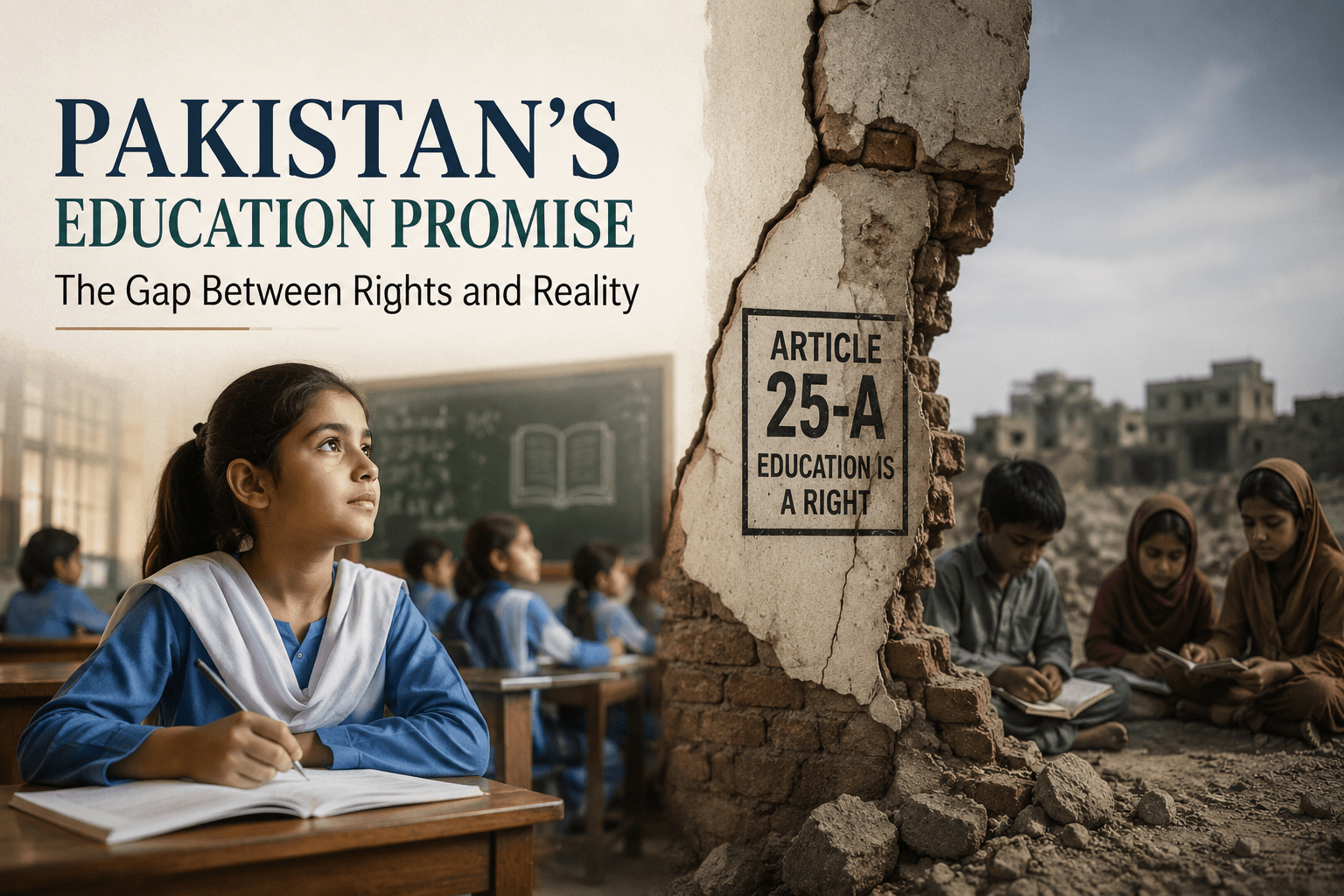
Pakistan’s Education Promise:The Gap Between Rights and Reality
Authored by Hussain Afzal Warraich and Hassan Afzal Warraich,
Pakistan has one of the youngest populations in the world and, on paper, one of the strongest promises to educate it. Article 25-A of the Constitution, added in 2010 with the 18th Amendment, makes free and compulsory education a right for every child, ages five to sixteen. But sixteen years later, that promise is mostly just that, a promise. Millions of children still aren’t in school, education spending has barely budged as a share of the economy, and the gap between what’s promised and what actually happens has become one of Pakistan’s quiet, but biggest, failures
This isn’t a simple story of heroes or villains. It’s about how things work in practice: tight budgets, a federal system that never fully took shape, a fast-growing youth population that keeps outpacing the money available, and political rewards that favor quick wins over slow, steady investment. The data show us the outline of the problem. What we really need to understand, and what this story tries to answer, is why this gap keeps sticking around and who’s really in a position to do something about it.
What the Numbers Show
Looking at the latest data from Pakistan’s Economic Survey for 2025-26, plus Labour Force and Higher Education Commission numbers, we see slow, patchy progress layered over a budget that isn’t growing much. [Source: Pakistan Economic Survey 2025-26, Finance Division, Government of Pakistan.]
The literacy rate (for people 10 and older) crept up from about 61 percent to 63 percent, a tiny jump. That headline hides a stubborn gender gap: male literacy is up to 73 percent, but female literacy just reached 54 percent, leaving a 19-point gap. Official numbers say out-of-school rates dropped from 38 percent to 28 percent, yet UNICEF and the World Bank still put the real number between 22.8 and 25.1 million children, most of them girls. [Sources: Pakistan Economic Survey 2025-26, Finance Division, Government of Pakistan; UNICEF Pakistan, Education page.]
Higher education is expanding too. There are now 278 universities (up from 269). Private institutions opened six new campuses; public ones, just three, a split that’s more a norm than an exception in Pakistan’s education history. The Economic Survey provides the latest university and education-sector figures. [Source: Pakistan Economic Survey 2025-26, Finance Division, Government of Pakistan.]
Then there’s the number that refuses to move: education spending as a share of GDP, stuck at 0.8 percent for two years straight. Although , total education spending went up, from almost 900 billion rupees to 962 billion (a 6.9 percent increase). but once we factor in inflation, it looks less like forward movement and more like treading water. Meanwhile, the Higher Education Commission’s development budget was cut from roughly Rs65 billion to Rs39.4 billion for 2025-26, a reduction of about Rs25.6 billion, even though the sector brought in new PhD hires and grew its teaching staff to almost 65,000. Budget reporting on the HEC allocation and the Economic Survey document the current-year funding and sector figures.
So, the system is managing small gains in enrollment and literacy, but the funding behind those gains is barely keeping pace.
A Public-Private Divide: A Historical Perspective
“Why has the public–private divide in education continued to widen?”
To get why Pakistan’s public and private schools look so different today, we have to revisit what changed in the 1970s.
Back in 1972, Zulfikar Ali Bhutto’s government nationalized private schools and colleges with an intention goal to make education less class-bound and unify the curriculum. In practice, the system got centralized, and neither funding nor quality kept up with the workload. The public system got overwhelmed. But the swung the other way under Zia-ul-Haq in the 1980s and 1990s, when private schools could re-register and grow. Low-cost budget private schools popped up quickly across cities and big towns, plugging the gaps that public schools couldn’t fill. That’s when the “two-track” system really took hold: public schools mainly for poorer or rural families, and private ones for the urban and better-off. That setup never really disappeared. [Source: Immigration and Refugee Board of Canada, “Country Review: Pakistan,” 1994, citing the increase in private educational institutions during the period.]
The 18th Amendment in 2010 gave education over to the provinces, hoping to hand decision-making to those closer to the students themselves. Since then, public and private education have both grown, but private schools have kept pulling ahead in new openings, a trend still clear this year. [Sources: Constitution of the Islamic Republic of Pakistan, 18th Amendment, 2010; Pakistan Institute of Development Economics, “NFC at a Crossroads: Revisiting Fiscal Federalism in Pakistan,” 2025.]
Whether that tilt is by design or just luck and drift is a core question here. The answer matters: if it’s a planning issue, better coordination could help. But if it’s built into the system, real change takes more than better plans.
Why the Public Money Stays Tight and NFC Award
“Why does the gap between what Pakistan promises on education and what actually happens keep sticking around?”
There’s no single reason for Pakistan’s stagnant education spending; there are at least four, and they all feed into each other.
First is money. Pakistan’s tax-to-GDP ratio has hovered between 9 and 11 percent for a decade, far below the 15 percent mark associated with steady growth, and well under the region’s 19.5 percent average. This isn’t just an education problem. It’s a whole-government money problem, squeezing every sector. Debt payments, defense, and general administration compete with education for limited fiscal space, while there is no constitutional formula that guarantees education a fixed share of total public spending.
Then there is the National Finance Commission, or NFC Award, which sits underneath much of this political economy. NFC is the constitutional mechanism for dividing federal tax revenues between the federation and provinces. The 7th NFC Award, agreed in 2009 and signed in March 2010, alongside the 18th Amendment, raised the provincial share of the divisible pool to 57.5 percent and was designed to give provinces more fiscal space for devolved responsibilities. Education, as a devolved subject, is one of those provincial responsibilities. But the same arrangement has left the federal government with 42.5 percent of the divisible pool while it still carries major obligations such as debt servicing and national development. The federal squeeze cannot be explained by the NFC alone: weak tax collection and the failure to sufficiently reform current expenditure and devolution also matter. That tension is central to understanding why the education budget remains tight.
Devolving education to provinces sounded good in theory, but there was an assumption placed that the capacity to match with the right skills, oversight tools was lacking, and the provinces lacked enough of own money. The PIDE NFC review further notes that after the 18th Amendment, provinces took on major devolved functions, while effective devolution to local governments remained incomplete. The result is a patchwork of outcomes that looks totally different from one province to the next, in addition to the ongoing debate over whether to take some powers back to the center, risking a return to the 1970s’ over-centralization mess.
Politics has a role, too. People who rely on public education tend to wield the least influence, while decision-makers often send their own kids to high-end elite private schools. Elections and job terms are short, so leaders chase projects with immediate rewards, not the slow grind of long-term investment that education needs.
And, finally, Pakistan’s youth boom makes things even harder. The school-age population keeps getting bigger, so each rupee has to stretch further every year. It doesn’t cause problems on its own, but it makes every other issue feel bigger.
Who Pays the Price
“What does it really take to connect millions of children outside mainstream education to schooling, higher education, or skilled work?
The fallout from a flat education budget isn’t abstract. It hits actual kids, families, and teachers. Behind the big numbers about who’s in or out of school is another one that’s tough to escape: learning poverty. The World Bank figures 77 to 78 percent of 10-year-olds in Pakistan can’t read or understand a simple text. That includes children enrolled in schools who just aren’t learning. So, just getting more children in classrooms doesn’t guarantee they’re learning, and both numbers matter. [Sources: World Bank, “Pakistan Learning Poverty Brief,” 2024; World Bank, “Fragile Gains, Enduring Challenges: Charting Pakistan’s Path Out of Poverty,” 2025.]
Inside public schools, problems stack up. Overcrowded classrooms, missing materials, not enough qualified science or mathematics teachers; these aren’t new, but they keep going unsolved. Many teachers, especially those on contract, deal with late or meager pay, so absenteeism and turnover go up. Principals often end up fundraising just to keep things running, covering for gaps but slowly undermining the profession’s status.
The Madrassah Students
An estimated 3.5 million children are enrolled in religious seminaries, largely outside the regular system. Attempts to bring them into the mainstream curriculum, exams, or practical training have hit political resistance. Whether these students actually have a realistic chance at higher education or jobs, or if they remain sidelined, is a question that still needs real answers.
And after all that, the effects ripple outward. Weak basic skills push many into unstable, low-wage jobs. The gap between private and public education keeps inequality rolling from one generation to the next. Under-education is directly linked to child labor, early marriage, and other risks.
A Constitutional Promise Without Teeth
“If education is a constitutional right, where is the accountability for Article 25-A?”
Article 25-A is clear: every child aged five to sixteen are entitled to free, compulsory education. But it lacks appropriate legislation to enforce this fundamental right.
No province has passed laws that really holds the state or provincial government accountable for the denial of this right.. Fourteen years after the amendment, that’s not just an oversight issue anymore; it seems built into how things actually work. Whether that counts as a constitutional violation is something for courts and lawmakers to debate. Still, there’s a giant gap: devolution put enforcement with the provinces, but none have set up the tools to make it happen.
It’s important to avoid mixing two stories, too. Article 25-A covers only ages five to sixteen. So, higher-education funding, including this year’s Higher Education Commission budget cut, is outside that constitutional promise. Both issues stem from the same money crunch, but they aren’t the same fight.
What Now?
None of the suggestions floating around, like a minimum education budget, a multi-year goal to hit 4-6 percent of GDP spending (what UNESCO and the SDGs call for), continued devolution with more technical support, or public-private partnerships, are offered here as recommendations. They’re ideas to put to people on the ground: those who run budgets, teach kids, or send their children to school. The real answers need to come from inside the system, not just theories on paperThe data can only showwhat is happening, but it does not say why, or who can change it. Those answers live with the people actually living this reality.
The Open Questions
“Is Pakistan’s tight education spending a result of debt-servicing pressures—or political choices made at home?”
Three big questions hang over everything here, and numbers alone cannot settle them.
First, should there be a real accountability system for Article 25-A, and why hasn’t one been built in fourteen years? Second, is Pakistan’s tight education spending because of tight debt-servicing pressures, like the IMF conditions, or is it due to political choices made at home? The answer needs to compare officials’ claims against what actual realities show us; rather than relying on assumptions about the causes of the crisis. And third, for the millions outside mainstream education (whether out-of-school kids or those in madrassahs), what would it really take to connect them to mainstream schooling, higher education, or skilled work?
These questions point to a larger problem: Pakistan’s education crisis is not simply about how much money is spent, but about how resources are prioritized, how responsibilities are enforced, and whose needs shape policy. The numbers show a country producing uneven outcomes while its education budget struggles to meet changing needs. Understanding why this gap persists—and what could realistically close it—requires listening to the people who work, teach, study, and make decisions within the system. That is where the next part of the conversation must begin. The conversations with people inside the system are where the real explanations, and maybe the path forward, will come into focus.
About the Authors: The authors are the participants of Ibtidah for Education Summer Experience Program (2026). They are both student cofounders of The Ravian Current, a youth-led digital media organisation pursuing journalism as a vehicle for inquiry, expression, and social impact. Through investigative reporting on social issues, STEM-focused video journalism, engineering projects, podcasts, and other independent work, they create and participate in, a platform that empowers young people to investigate the world, communicate ideas, and participate meaningfully in public discourse.
find them at:
https://www.instagram.com/theraviancurrent/